What are the Career and Future Prospects of Prompt Engineering?

TL;DR
Prompt engineering turns plain-language instructions into reliable AI output, and it pays. Anthropic famously listed a Prompt Engineer role at up to $335,000, and certificates now sit inside university curricula. The job blends designing, testing, and refining prompts with bias mitigation and documentation. Useful skills span linguistics, light Python, data analysis, and domain expertise. The future trend: more automation, broader industry use, and tighter integration with other AI techniques.
Within the field of generative AI, prompt engineering has emerged as a highly sought-after profession. Organizations are enticing top talents with salaries as high as $335,000 to attract them.
But why is prompt engineering in such high demand? Unraveling the behavior of massive AI models is both a science and an art. Even the most skilled technical experts can find themselves perplexed by the remarkable capabilities exhibited by large language models (LLMs), which serve as the foundation for AI chatbots like ChatGPT.
Considering the complexity involved, it is no surprise that prompt engineering jobs are in high demand among employers. Additionally, prompt engineering certifications are quickly becoming part of university curricula.
So, what exactly does a prompt engineer do?
What does a Prompt Engineer do?
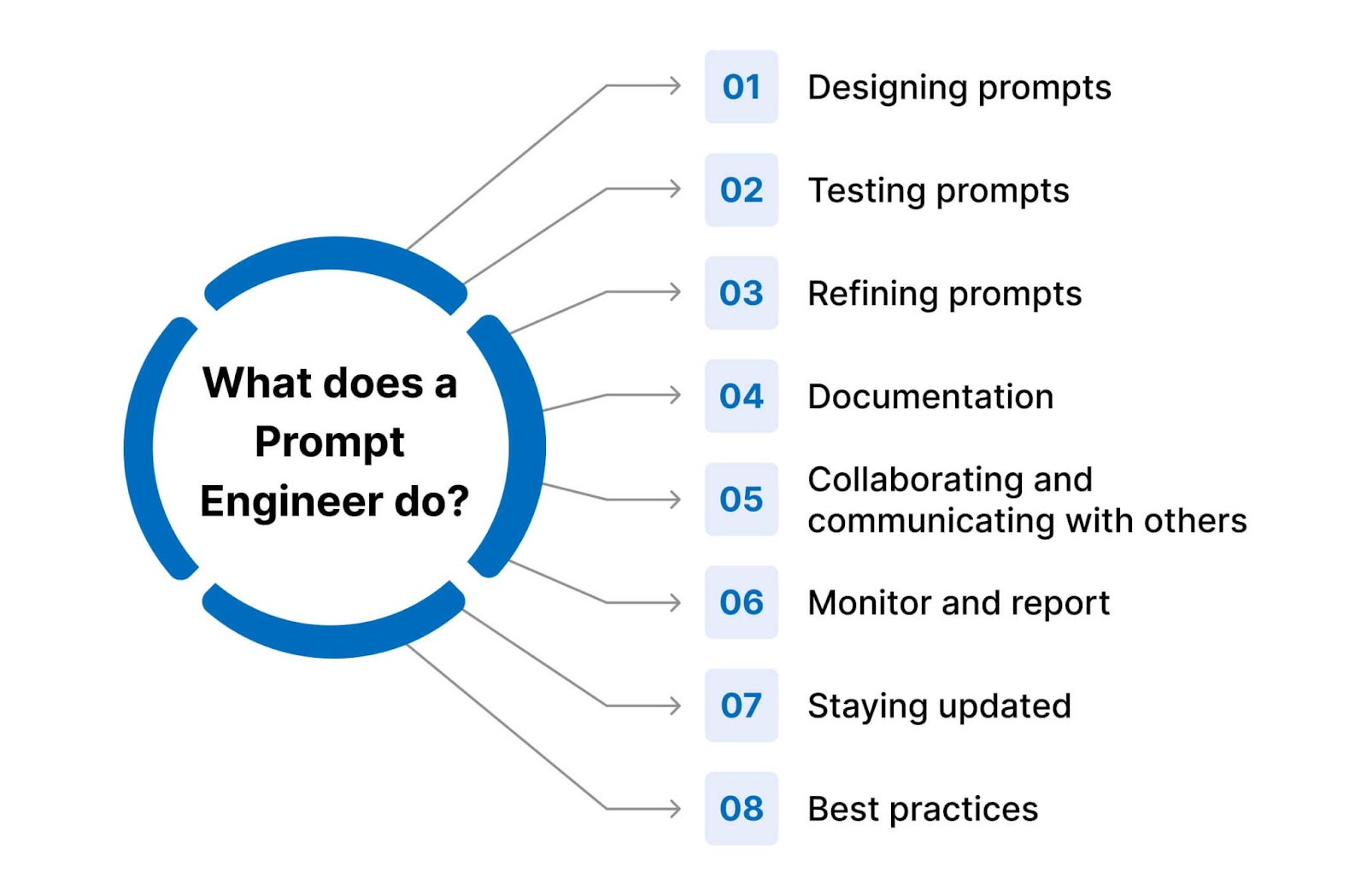
As a prompt engineer, you might be responsible for designing prompts that guide an AI's responses, testing and refining prompts, ensuring the AI's outputs meet the necessary standards of accuracy and relevance, and working on bias mitigation.
Your job description, job role, or job responsibilities can include:
- Designing prompts: Creating initial prompts for specific tasks based on an understanding of the AI model and the task requirements.
- Testing prompts: Experimenting with different prompts to see how the AI model responds and evaluating the usefulness of the responses.
- Refining prompts: Adjusting the prompts based on the AI's responses to improve the results.
- Documentation: Documenting successful prompts and strategies for future reference and for sharing with other team members.
- Collaborating and communicating with others: Collaborating with other team members, such as AI researchers or application developers, to ensure that the prompts meet the needs of the specific application.
- Monitor and report: Analyze and create a report of prompt performance, and continuously monitor areas of improvement for prompt development.
- Staying updated: You would need to stay apprised of the latest developments in the domain of AI, prompts and even NLP and machine learning.
- Best practices: Create best practices for different teams to help them understand and use the prompts most effectively.
Do remember that based on the role you are applying for and the organization you are applying with, the job responsibilities; the requirement for professional prompt engineering certifications, and professional experience may vary.
Read More: 8 Tips to Write Effective ChatGPT Prompts
Skills needed to become a Prompt Engineer
- Understanding of AI models: A solid understanding of how AI language models work, including their training process and how they generate responses, is crucial.
- Problem-solving: Prompt engineering often involves a lot of trial and error. Being able to approach a problem creatively and come up with different possible solutions is an important skill.
- Data analysis: To evaluate the effectiveness of different prompts, you'll need to be able to analyze the responses of the AI model, which often involves working with large amounts of text data.
- Attention to detail: Small changes in the wording or format of a prompt can make a big difference to the AI's response. Being attentive to these small details is therefore important.
- Knowledge of linguistics: Understanding how language works, including syntax, semantics, pragmatics, and discourse, can help in crafting effective prompts.
- Coding skills: Depending on the specific role, some level of coding skill may be required, particularly in Python, which is the language most commonly used for interacting with AI models.
- Understanding of AI ethics and safety: It's important to understand the potential ethical and safety issues associated with AI usage, and how these can be mitigated through prompt engineering.
- Subject matter expertise: Oftentimes, prompt engineers are required to fine-tune the prompts for a specific field such as law, healthcare, financial technology, or ecommerce. In such a case, they would need expertise in the said field in order to craft useful, powerful solutions for the AI.
- Open to experimentation: Since prompt engineering is a continuous, iterative process, it involves a lot of experimentation. As a prompt engineer you would require to be patient and be open to experimenting and learning continuously.
Career prospects in Prompt Engineering
With the growing adoption of AI technologies, the demand for specialists who can effectively interact with these systems is on the rise.
The career prospect in prompt engineering is both promising and diverse. However, success in it requires dedication, continuous learning, and a deep understanding of both AI and the specific requirements of the tasks at hand.
Career in prompt engineering can present substantial opportunities. Some of them are:
- Consulting opportunities: As more organizations seek to leverage AI, there's also a growing demand for consultants who can advise them on prompt engineering and other aspects of AI use.
- Collaboration with AI research: Prompt engineers often work closely with AI researchers, which can provide opportunities to contribute to cutting-edge AI development and research.
- Cross-disciplinary opportunities: Because prompt engineering is about communication with AI, it combines elements of several fields, including linguistics, psychology, and computer science. This cross-disciplinary nature could open doors to a wide range of career paths in different industries and domains.
- Career growth: As AI continues to evolve and find new applications, prompt engineers who keep their skills and knowledge up to date will likely find numerous opportunities for career advancement. There's also scope to move into related areas of AI and machine learning, such as model training, AI ethics, and more.
Future trends in Prompt Engineering
With AI, prompt engineering is set to evolve alongside it, opening up new possibilities and challenges. Here are some trends to watch for:
- Increased sophistication: As AI language models become more sophisticated, we can expect to see the same from prompt engineering. The techniques used to guide AI's responses will likely become more advanced and nuanced, enabling us to extract even more value from these models.
- Automated prompt engineering: Machine learning techniques may eventually be used to automate some aspects of prompt engineering, further optimizing the process of generating effective prompts.
- Broader applications: As more industries and sectors embrace AI, the applications for prompt engineering will likely grow. From healthcare to entertainment to finance, there are potential uses for AI language models, and prompt engineering, in nearly every field.
- Ethics and bias mitigation: As awareness of the ethical implications of AI grows, bias mitigation will become an increasingly important aspect of prompt engineering. We can expect to see more research and more advanced techniques aimed at ensuring AI models produce fair, unbiased responses.
- Improved evaluation metrics: As prompt engineering matures as a discipline, we can expect to see more standardized and sophisticated metrics for evaluating the effectiveness of prompts. This will help prompt engineers to better understand the impact of their work and continuously improve their prompts.
- Integration with other AI techniques: Prompt engineering will likely become more integrated with other AI techniques, like reinforcement learning and transfer learning. This could open up new possibilities for guiding AI's behavior and improving its outputs.
With its potential to automate tasks, generate high-quality content, and drive efficiencies, it's a skill that holds increasing relevance in today's AI-driven world.
By grasping these fundamentals and applying them effectively, businesses can unlock the full potential of AI, enhancing their operations and paving the way for innovative applications and opportunities.
Have you explored prompt engineering or are you working as a prompt engineer? Let us know your thoughts and experience by writing to us.
Frequently Asked Questions
What does a prompt engineer actually do?
A prompt engineer designs the instructions that steer an AI model's responses, then tests and refines them until the output hits the needed accuracy and relevance. The role also covers bias mitigation, documenting what works, and collaborating with researchers or developers. Think of it as translating a fuzzy business goal into precise language a model can act on reliably.
How much can a prompt engineer earn?
Top listings have gone high: Anthropic posted a Prompt Engineer and Librarian role with a range of $175,000 to $335,000. That headline figure is an outlier, not the norm, but it signals how much value companies place on people who can reliably wrangle large language models. Most roles land well below that ceiling, with pay scaling by domain expertise and seniority.
Do you need a computer science degree to become a prompt engineer?
No degree is strictly required, and Anthropic's well-known listing leaned on a creative hacker mindset over formal credentials. Light Python helps for some roles, but the core skills are problem solving, attention to detail, and a feel for language. Subject matter expertise in a field like law, healthcare, or fintech often matters more than a CS pedigree.
What skills do I need to learn prompt engineering?
Start with a working understanding of how LLMs generate responses, then build problem-solving patience for the trial-and-error loop. Attention to detail is big, since small wording changes shift outputs sharply. Linguistics knowledge, basic data analysis, light Python, and awareness of AI ethics and bias round out a strong base, plus deep knowledge of whatever industry you write prompts for.
Is prompt engineering a future-proof career or will AI automate it away?
Parts of it will automate: machine learning is already being used to generate and optimize prompts, so rote work shrinks. The skill itself keeps evolving, getting more sophisticated and spreading into more industries while merging with techniques like reinforcement learning. The durable career move is treating prompt engineering as a gateway into adjacent AI work such as model evaluation, fine-tuning, and AI ethics, not as a fixed job title.
Sources
- CBS News: companies hiring prompt engineers, Anthropic pay of $175,000 to $335,000
- Entrepreneur: prompt engineering job can pay up to $335,000, even without an engineering degree
- Anthropic Prompt Engineer job listing (Greenhouse)
- Coursera Prompt Engineering Specialization, offered by Vanderbilt University (prompt engineering in university curricula)
Keep reading
The archive →How to Learn Prompt Engineering?
Explore following topics in this article: what is prompt engineering, chat gpt prompt engineering, prompt engineering chatgpt, prompt engineering guide, prompt engineering jobs, prompt engineering certification, learn prompt engineering, openai prompt engineering
PROMPT ENGINEERINGPrompt-based Learning - Why do NLP models, like ChatGPT, use it?
Prompt-based learning is a dynamic technique offering a unique way to instruct AI, enriching their responses and interactions.
PROMPT ENGINEERINGWhat is Prompt Engineering?
Explore following topics in this article: what is prompt engineering, chat gpt prompt engineering, prompt engineering chatgpt, prompt engineering guide, prompt engineering jobs, prompt engineering certification, learn prompt engineering, openai prompt engineering
From The Cut
All takes →- Claude Code vs Cursor in 2026: Which AI Coding Tool Should You Use?
- Claude Code vs GitHub Copilot in 2026: Two Different Shapes of the Same Job
- Claude Fable 5 vs Opus 4.8: When the Cheaper Claude Actually Wins
- Claude Opus vs Sonnet (4.8 vs 4.6): Which One Do You Actually Need?
- Claude Sonnet vs Haiku in 2026: When the Cheapest Claude Wins
- Claude vs ChatGPT in 2026: The Honest Operator Comparison