Prompt-based Learning - Why do NLP models, like ChatGPT, use it?

TL;DR
Prompt-based learning is how models like ChatGPT do new tasks without retraining: instead of feeding the model thousands of labeled examples per task, you guide a pretrained model with a well-crafted prompt and let it reason from what it already knows. The payoff is flexibility, faster training, and plain-language access. The catch is that output quality leans hard on prompt design, and results can be inconsistent or tough to explain.
Traditionally, language models relied on labeled datasets that were used for supervised training. This often resulted in a lack of adaptability and required substantial retraining for new tasks. They also struggled with abstract concepts due to the difficulty of providing clear labeled data for such tasks.
Enter, prompt-based learning.
This is a learning technique by which the language models can use the knowledge acquired during training to learn new things and perform various tasks.
An evolved approach to NLP learning, it allows the models to be trained under unsupervised conditions on unlabeled data. This way the model can “think” for itself based on the previous conversations and input-prompts. The only thing required here is specificity and clarity of the prompt.
Prompt-based learning leverages an intelligent query, or a "prompt," to guide the model's responses.
Read more: AI-based Chatbots - Why Marketers and Start-up Founders Need to Pay Attention?
How does prompt-based learning work?
At its core, prompt-based learning alters the way language models generate responses that are more dynamic and versatile. The reason: it learns by using the knowledge of the pretrained language models without needing retraining on new tasks or activities.
Furthermore, in prompt-based learning technique, fine-tuning is an integral part of it. By fine-tuning, you can refine the model's behavior, ensuring its responses align more closely with the desired output. By adjusting the model's parameters during training, fine-tuning makes prompt-based learning more effective and precise.
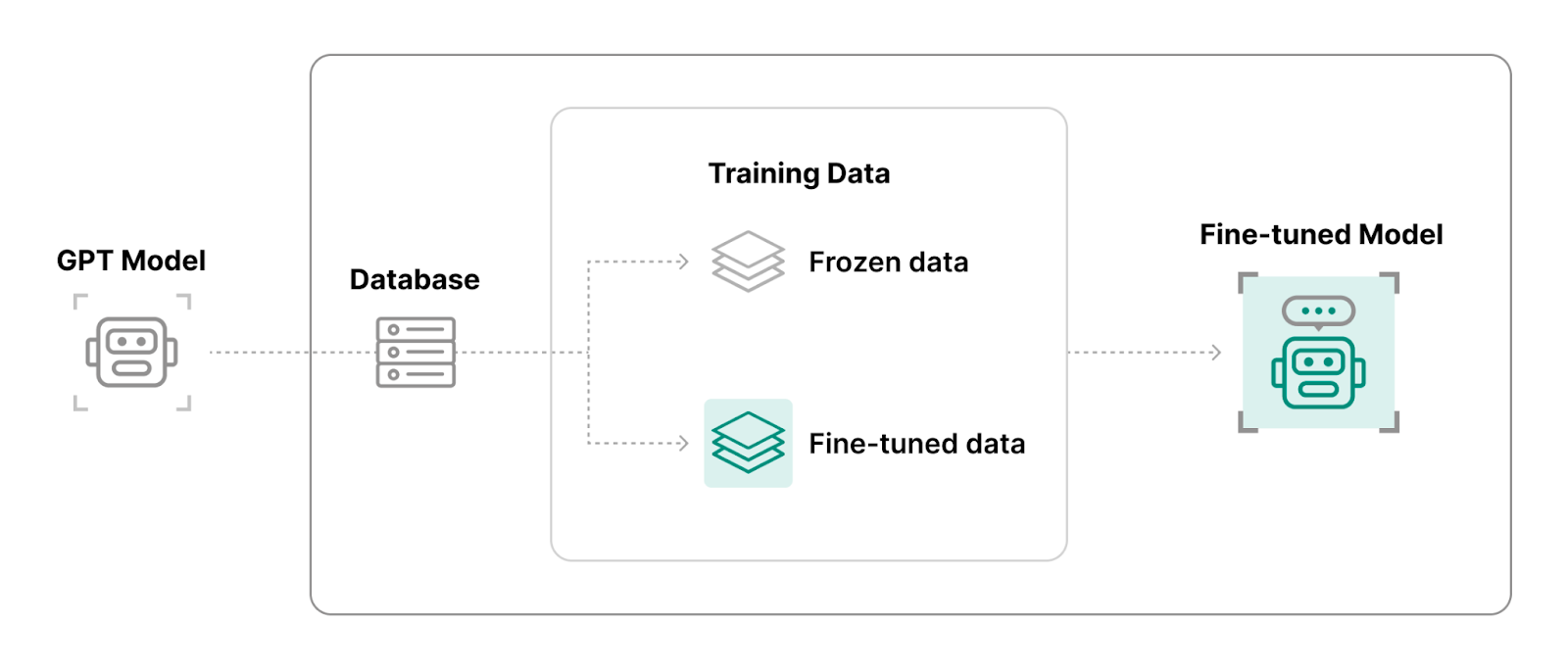
To further reduce the misinterpretation of prompts by the AI model, prompt engineering is used.
Prompt engineering is the intentional design and crafting of prompts to improve the performance of AI models which are trained using prompt-based learning techniques.
In prompt engineering, developers intricately design prompts following an iterative process. This includes considering factors such as clarity, specificity, and relevant instructions. By carefully engineering prompts, developers can reduce the chances of misinterpretation or irrelevant outputs.
Read more: 8 Tips to Write Effective ChatGPT Prompts
What are the benefits of prompt-based learning?
Prompt-based learning offers several benefits in training language models:
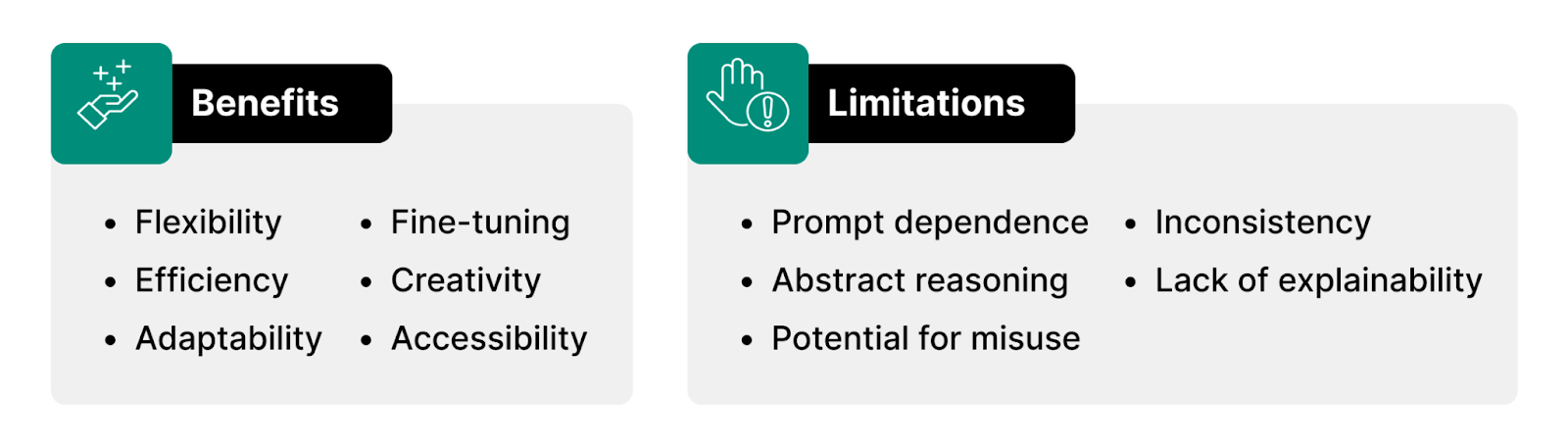
- Flexibility: It allows for dynamic and versatile responses, providing a flexible way for models to handle a wide array of tasks.
- Efficiency: As it doesn't require large amounts of labeled data for each specific task, it is much faster and more efficient to train the AI model, as compared to traditional supervised learning.
- Adaptability: It enables a language model to tackle diverse tasks without extensive retraining.
- Fine-tuning: As it allows fine-tuning of the language model, it ensures that the model's response is aligned more closely with the desired output.
- Creativity: It can potentially generate more creative or unexpected responses as the model interprets a prompt rather than following a strict predefined pattern.
- Accessibility: For the end user, interacting with a prompt-based model can be as simple as writing a sentence, making these models more accessible.
What are the limitations of prompt-based learning?
Prompt-based learning despite its advantages, comes with own limitations:
- Prompt dependence: The quality of the output heavily relies on the design of the prompt. Poorly designed prompts may lead to inaccurate or nonsensical responses.
- Abstract reasoning: While prompt-based learning can handle a wide range of tasks, however, it can struggle with tasks that require deep comprehension or abstract reasoning.
- Potential for misuse: Without proper safeguards, prompt-based learning models can generate harmful or biased content if given inappropriate prompts.
- Inconsistency: Due to its probabilistic nature, the same prompt might yield different responses at different times, leading to inconsistency in output.
- Lack of explainability: It can sometimes be difficult to understand why a model produced a particular output in response to a given prompt. This lack of transparency can make debugging and model improvement challenging.
Researchers are continually exploring ways to mitigate these challenges, pushing the boundaries of what we can achieve with prompt-based learning.
What is the future of prompt-based learning?
The future of prompt-based learning is quite promising, with continual efforts to refine and optimize this process We can expect language models to deliver more nuanced and intelligent responses.
Below are the advancements that we can expect to see:
- Improved prompt design: The development of methodologies for crafting effective prompts will continue to be a major area of research, leading to more accurate and interactive responses from language models.
- Better fine-tuning techniques: Researchers are working on fine-tuning techniques that can make prompt-based learning more effective, allowing models to generalize better and reduce bias responses.
- More efficient training methods: New approaches to training, such as few-shot learning, zero-shot learning, and transfer learning, are being explored to make prompt-based learning less resource-intensive.
- Ethical and safe AI: As the field matures, there will be a greater focus on developing safeguards to prevent misuse and reduce harmful or biased outputs from prompt-based learning models.
No doubt, prompt-based learning is transforming the landscape of AI language models, making it possible to have more human-like conversations with the AI.
By combining the power of neural networks and the flexibility of task-specific prompts, we might just unlock the potential that this technique holds.
What has been your experience with prompts and language models? Let us know here.
Frequently Asked Questions
What is prompt-based learning in NLP?
It is a technique where a pretrained language model performs new tasks by being guided with an intelligent query (a prompt) rather than being retrained on a fresh labeled dataset for each task. The model draws on knowledge gained during training and responds based on the prompt and prior context. The whole thing hinges on writing prompts with enough clarity and specificity.
How is prompt-based learning different from traditional supervised training?
Traditional supervised training relies on large labeled datasets and needs substantial retraining whenever you add a new task, which makes it slow and rigid. Prompt-based learning skips the per-task retraining by reusing a pretrained model and steering it with prompts instead. That is why it is faster, more efficient, and far more adaptable across different tasks.
What is prompt engineering and how does it relate to prompt-based learning?
Prompt engineering is the deliberate, iterative design of prompts to get better, more reliable output from models trained with prompt-based learning. Developers tune for clarity, specificity, and relevant instructions to cut down on misinterpretation and irrelevant answers. In short: prompt-based learning is the method, and prompt engineering is the craft of feeding it good inputs.
What are the main limitations of prompt-based learning?
Output quality depends heavily on prompt design, so a sloppy prompt can produce inaccurate or nonsensical answers. The approach can also struggle with deep comprehension or abstract reasoning, and its probabilistic nature means the same prompt may return different responses at different times. On top of that, models can be hard to explain and, without safeguards, can generate biased or harmful content.
Why do GPT models like ChatGPT use prompt-based learning?
Because it lets one pretrained model handle a wide range of tasks without retraining for each one, which is what makes ChatGPT feel general-purpose. It also makes the model accessible: for the end user, getting an answer can be as simple as writing a sentence. The trade-off is that results lean on prompt quality and can vary between runs.
Sources
Keep reading
The archive →How to Learn Prompt Engineering?
Explore following topics in this article: what is prompt engineering, chat gpt prompt engineering, prompt engineering chatgpt, prompt engineering guide, prompt engineering jobs, prompt engineering certification, learn prompt engineering, openai prompt engineering
PROMPT ENGINEERINGWhat are the Career and Future Prospects of Prompt Engineering?
Explore following topics in this article: what is prompt engineering, chat gpt prompt engineering, prompt engineering chatgpt, prompt engineering guide, prompt engineering jobs, prompt engineering certification, learn prompt engineering, openai prompt engineering
PROMPT ENGINEERINGWhat is Prompt Engineering?
Explore following topics in this article: what is prompt engineering, chat gpt prompt engineering, prompt engineering chatgpt, prompt engineering guide, prompt engineering jobs, prompt engineering certification, learn prompt engineering, openai prompt engineering
From The Cut
All takes →- OpenAI vs Anthropic in 2026: Which Company Should You Build On?
- Perplexity vs ChatGPT in 2026: Which Wins for Real Research?
- The Best AI Agent Frameworks in 2026: An Operator's Ranking
- The Best AI Agents in 2026: What Actually Ships Work
- The Best AI Apps in 2026: The Ones Actually Worth Your Time
- The Best AI Browser Agents in 2026: What Actually Clicks Through